We’re very excited to announce the addition of automatic synching for eWallet GO!™ on Windows PC and iOS. With this update, eWallet GO! can automatically save an encrypted backup of your info to either Google Docs or Dropbox whenever you make a change! And if you set up eWallet GO! on another device to synchronize with the same service, eWallet GO! will automatically synchronize the information between the devices. No more manual backup and restore!
This feature is only available on Windows PC and iOS at this time, but we hope to add it to eWallet GO! on Mac, Android, and Windows Phone in the future.
As if that weren’t enough, we also added full Landscape support to eWallet GO! on iOS.
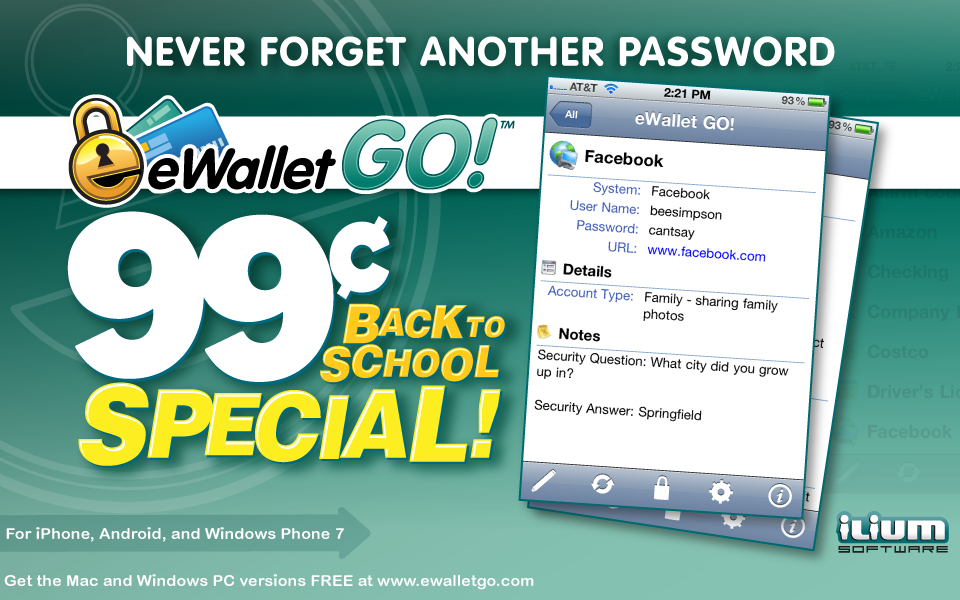
To celebrate this release, we’re offering a Back-to-School Special! For a limited time, you can get eWallet GO! for your mobile device (iOS, Android, or Windows Phone) for just 99 cents! But wait…there’s more! You can also get eWallet GO! on your Windows PC or Mac for free!
What are you waiting for? Hop over to http://www.ewalletgo.com and get your copies of eWallet GO! before the sale ends!
By popular request, we just released an update to the eWallet GO!™ Conversion Utility\* that lets you easily move data exported from LastPass into eWallet GO!
It’s easy to do! Just export the LastPass data and save it into a text file, then run through the Conversion Utility wizard. That’s it! The utility does all the rest!
We hope this helps those of you who were looking for a solution like this!
For more information about eWallet GO! click here.
To access the eWallet GO! Conversion Utility click here.
To learn more about converting to eWallet GO! from LastPass, click here.
\* Previously known as the Wallet Transfer Utility
Time for a new assignment for our advisory board! Today I want to hear what you have to say about Android. Let me start by laying out the pros and cons as I see them.
PROS
It’s Google. Google = Success in the technology market right now which bodes well for the device.
It’s a pretty nice OS from a user perspective. Nice UI. Decent look.
It might be the “other phone” along with the iPhone.
CONS
Every OEM can tweak the UI meaning an potentially nightmarish (and expensive) development environment.
So - can you support or contradict the pros and cons? Do you have other pros and cons you’d want to add? How about personal experience with folks who have switched to or abandoned Android? As I’ve said, this is a platform we have not ruled out but I’d love to hear your opinion!
And as a extra motivation, if you post a response with your opinions TODAY you’ll be entered into a drawing for a special prize!
I was excited to see that NewsBreak Lite is now available forfree from Microsoft’s Total Access service for Windows Mobile. NewsBreak Lite is the free version of our NewsBreak feed reader/podcast grabbing software. The app is great and the price is right so if you have a Window Mobile device you definitely want to grab a copy.
If you aren’t familiar with the Total Access service, here is the official blurb from MS:
Total Access is your guide to all the things you can do with your Windows Mobile phone. Make your phone unique with free ringtones, games and themes, find helpful software and other extras that further enhance your phone, and get premium help and support from user forums, so it’s easier than ever to get more done on the go—that’s Total Access.
It’s a pretty cool service for Windows Mobile users. Definitely something you want to check out even if you already have NewsBreak (or RSSHub which is the HTC branded version of NewsBreak.) They have a ton of great stuff and are adding more all the time.
I’ve read some really interesting comments regarding the problems in the AppStore. One thing that came up a few times, however, is something like this: “Who cares? This sort of stuff has no impact on the consumer.” I’m posting today to explain why this is a myth - problems with the AppStore that developers are having directly and negatively impact the consumer.
If you’d like to hear why a silly icon rejection is a big deal to you, read on…
I’m not going to frame this with a lot of color text - let’s get right to the point.
1. No Features For You! Apple is preventing you, as a consumer, from getting upgrades and features you deserve. Right now, users of eWallet can’t use Copy & Paste because Apple delayed our update over an icon.
2. New Features OR AppStore Compliance Updates: You Choose This sort of stuff eats up developer time which in turn cheats you out of better products. Instead of focusing on things that will actually benefit our customers, we’re messing around playing AppStore acceptance games.
3. Diminishing Returns
No matter how good a platform or outlet is, developers will only take so much. At some point the system become onerous enough that it makes more sense to focus on other markets. This is the long term cost of this sort of thing – and at some point there WILL be a powerful competitor.
4. Too Risky for Good Products
Illogical, petty, and ever changing acceptance requirements will cause developers to think twice before making a major investment in an iPhone application. If you don’t know whether your app will even get in, you reduce your initial investment to protect yourself. That means you, as a consumer, end up with apps that don’t hold a candle to what a developer might have risked in a more stable environment.
None of these are speculation – in every case I’ve seen it happen in the AppStore already, or in the case of #3, I’ve seen it happen on other platforms. And remember, the problem they are talking about isn’t just about us – this is affecting numerous developers.
So yes, these little and seemingly silly issues have a VERY REAL COST to the consumer. It’s easy to think “Meh, not my problem.” but in the end (as always) the consumer is the one who pays the price.
It’s Friday, Apple still hasn’t approved the new version of eWallet, and I want to post something new on the blog, so I’m going to drag out the soapbox and talk about privacy issues. As I said in my Pinchgate post, I’m very sensitive to electronic privacy issues. I’m perfectly happy to share information, but I want to be part of the process. I want an application to ask before it starts sending my secrets off to some distant server for compilation and analysis. At the same time, tracking web usage is a universal aspect of the internet, so where does that fall in the privacy debate?
If you’re interested in this sort of thing, read on after the jump to hear me toss out some ideas!
The Internet = A Public Space
If you don’t already know it, websites track a ton of information about the people that visit them. Unique visitors, how long they linger on individual pages, what files they download, how they got to the site, or even where they go when they are finished. And it isn’t necessarily the person who owns the site that is doing this - these are all things a typical internet provider will track for the people who use them to host a website.
In general, folks aren’t too worried about this. My theory on why, is that people view the internet as “public space.” It’s like a park, a grocery store, or a government building. When you “walk around” the web, you have an expectation that someone might be watching you. Do you care? Most people don’t. So what if I appear on WalMart’s security tapes? What do I care if a traffic camera picks up my car driving down the street.
The internet is the same way. I have no greater expectation of privacy browsing books on Amazon than I do hanging out and thumbing through books in Borders. I’m out in public - someone is probably watching. Even on “secure” sites like banks, there is a real world analogy. Although I expect the transactions I make at the bank to remain secret, at a real bank I’m driving up to the bank out in the open, walking down the sidewalk and in the door in full view, and talking to a teller out loud (others might hear). There is a limit to privacy at a real world bank, and a bank website is much the same.
Software and My Computers = Private Space
On the other hand there is software (and the computers it runs on). People have an expectation of privacy here. I would no sooner expect a game I purchased to send personal information about me back to the developer than I would expect my refrigerator to send information about what food I eat, how much beer I drink, or what non-food items I store in my fridge back to Whirlpool. If my fridge actually DID this, I’d be pretty freaked out and probably get a new fridge.
The same with my computer. Although I access the internet through a browser from my computer, the space of my computer itself is my personal space. I’ll accept a CC camera at a grocery store, but I won’t accept one in my living room.
There are, however, real world exceptions. I might allow a Nielsen ratings box to be installed on my television, or fill out a survey for a marketing company about my buying habits. But there is a difference…
Real World Permitted Spying vs Virtual Permitted Spying
The first key difference between the sort of private life spying that goes on in the real world (Nielsen box/survey) is that in the real world, retailers and marketers ALWAYS ask permission first. A handy fact about the real world is that they pretty much have to - I’m not going to accidentally fill out a survey. Also, there are laws that punish people that spy on us without our explicit permission.
A second difference is that real world retailers and marketers almost always give me something back for my effort. A freebie, coupons, or some other compensation for sharing my information. Take those stupid grocery store cards as an example. If you use one, they track your buying habits, but in exchange you get lower prices and targeted coupons at checkout. It’s worth it to me.
An Unfortunate Confusion
The problem is that software developers are getting confused. Now to be fair, some folks just don’t care, but I know a lot of software developers and I really believe that it is more an issue of confusion than purposeful wrongdoing.
First, they’re mixing up private space and public space. Just because we will accept a traffic camera, doesn’t mean we’ll let the government put a camera in our living room. The same is true for the internet. Just because we’ll accept data tracking on a website, doesn’t mean we’re okay with it in our favorite piece of software. And just like real life, although the technology is the same (a CC camera is a CC camera no matter where you put it) whether you are tracking web access or software use, this doesn’t mean we will accept that technology in all places.
Second, they are taking without giving. Traditionally, in our market based economy, we get when we give. If you want me to fill out a survey about my laundry habits, you’d better send me a little box of detergent. Or if the information is being given with no direct compensation, it had better be optional. I don’t mind volunteering, but if it isn’t a choice I’m no longer a volunteer.
Third, just because you can do something (and do it easily in many cases), doesn’t mean it’s okay to do it. I can sneak over to my neighbors house in the morning and peek in the window while they are getting ready for work. This doesn’t mean its okay. Software is powerful - we can do a LOT of things with it, but as Ben Parker once said, “With great power comes great responsibility.”
Wrapping It Up
If you managed to read this whole post, thanks! I’ll take that as a compliment. :) In the meantime, encourage your favorite software developer to ask before they spy. I’m sure many of us are happy to chip in with information that might make our favorite products better, but there is a very clear line between our private space and our private space and developers need to make sure that they don’t cross it.
 We’re very excited to announce the addition of automatic synching for eWallet GO!™ on Windows PC and iOS. With this update, eWallet GO! can automatically save an encrypted backup of your info to either Google Docs or Dropbox whenever you make a change! And if you set up eWallet GO! on another device to synchronize with the same service, eWallet GO! will automatically synchronize the information between the devices. No more manual backup and restore!
 Time for a new assignment for our advisory board! Today I want to hear what you have to say about Android. Let me start by laying out the pros and cons as I see them.
 I was excited to see that NewsBreak Lite is now
 It’s Friday, Apple still hasn’t approved the new version of eWallet, and I want to post something new on the blog, so I’m going to drag out the soapbox and talk about privacy issues. As I said in my